
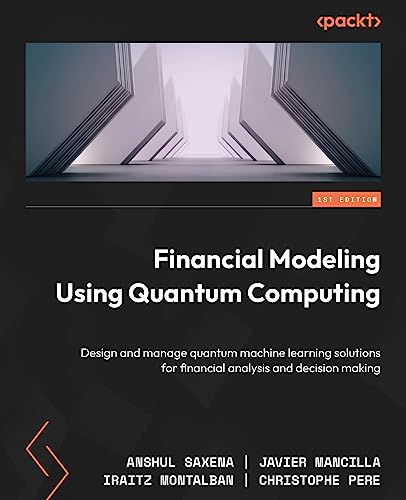
Financial Modeling Using Quantum Computing
Material type: TextPublication details: Mumbai Packt Publishing Ltd 2023Description: 271pISBN:
 - 9781804618424
- 006.38 SAX/F
| Item type | Current library | Call number | Copy number | Status | Date due | Barcode | Item holds | |
|---|---|---|---|---|---|---|---|---|
 Reference
|
IIIT Kottayam Central Library Reference | 006.38 SAX/F (Browse shelf(Opens below)) | Not For Loan | 3097 | ||||
 Books
Books
|
IIIT Kottayam Central Library General Stacks | 006.38 SAX/F (Browse shelf(Opens below)) | 1 | Available | 3098 |
Browsing IIIT Kottayam Central Library shelves, Shelving location: Reference Close shelf browser (Hides shelf browser)


Part 1: Basic Applications of Quantum Computing in Finance
Chevron down icon
Part 1: Basic Applications of Quantum Computing in Finance
Chapter 1: Quantum Computing Paradigm
Chevron down icon
Chapter 1: Quantum Computing Paradigm
The evolution of quantum technology and its related paradigms
Basic quantum mechanics principles and their application
The business application of quantum computing
Summary
Chapter 2: Quantum Machine Learning Algorithms and Their Ecosystem
Chevron down icon
Chapter 2: Quantum Machine Learning Algorithms and Their Ecosystem
Technical requirements
Foundational quantum algorithms
QML algorithms
Quantum programming
Quantum clouds
Summary
References
Chapter 3: Quantum Finance Landscape
Chevron down icon
Chapter 3: Quantum Finance Landscape
Introduction to types of financial institutions
Key problems in financial services
Summary
Further reading
References
Part 2: Advanced Applications of Quantum Computing in Finance
Chevron down icon
Part 2: Advanced Applications of Quantum Computing in Finance
Chapter 4: Derivative Valuation
Chevron down icon
Chapter 4: Derivative Valuation
Derivatives pricing – the theoretical aspects
Machine learning
Quantum computing
Summary
Further reading
References
Chapter 5: Portfolio Management
Chevron down icon
Chapter 5: Portfolio Management
Financial portfolio management
Financial portfolio diversification
Financial portfolio simulation
Portfolio management using traditional machine learning algorithms
Quantum algorithm portfolio management implementation
Conclusion
Chapter 6: Credit Risk Analytics
Chevron down icon
Chapter 6: Credit Risk Analytics
The relevance of credit risk analysis
Data exploration and preparation to execute both ML and QML models
Implementation of classical and quantum machine learning algorithms for a credit scoring scenario
Quantum Support Vector Machines
Conclusion
Further reading
Chapter 7: Implementation in Quantum Clouds
Chevron down icon
Chapter 7: Implementation in Quantum Clouds
Challenges of quantum implementations on cloud platforms
Cost estimation
Summary
Further reading
References
Part 3: Upcoming Quantum Scenario
Chevron down icon
Part 3: Upcoming Quantum Scenario
Chapter 8: Simulators and HPC’s Role in the NISQ Era
Chevron down icon
Chapter 8: Simulators and HPC’s Role in the NISQ Era
Local simulation of noise models
Summary
Further reading
References
Chapter 9: NISQ Quantum Hardware Roadmap
Chevron down icon
Chapter 9: NISQ Quantum Hardware Roadmap
Logical versus physical qubits
Circuit knitting
Error mitigation
Annealers and other devices
Summary
Further reading
References
Chapter 10: Business Implementation
Chevron down icon
Chapter 10: Business Implementation
The quantum workforce barrier
Infrastructure integration barrier
Identifying the potentiality of advantage with QML
Funding or budgeting issues
Market maturity, hype, and skepticism
Road map for early adoption of quantum computing for financial institutions
Quantum managers’ training
Conclusions
References
Index
Chevron down icon
Index
Why subscribe?
Other Books You May Enjoy
Chevron down icon
There are no comments on this title.